
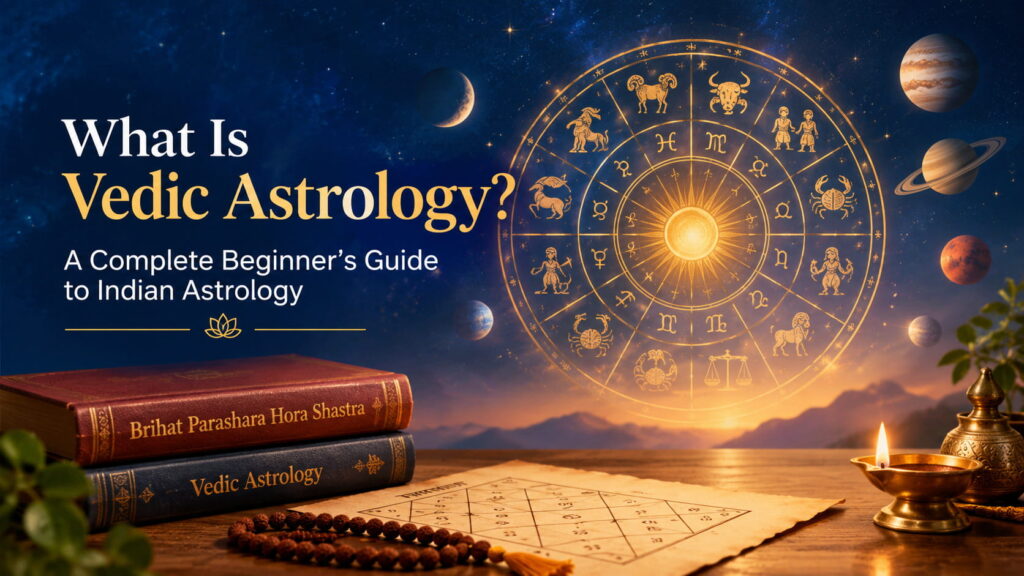
What Is Vedic Astrology? A Complete Beginner’s Guide to Indian Astrology
Vedic Astrology, or Jyotish Shastra, is an ancient Indian system that helps to calculate planetary positions and birth charts using the birth date and time. It is traditionally used to explore the personality, life patterns, relationships, and personal growth of an individual 01. Introduction to Vedic Astrology What is Vedic Astrology? Jyotisha (which can be translated as ‘the science of light’) is the combination of mathematical astronomy and Vedic lore to show how time and our freewill affect the quality of our destiny. Vedic Astrology is concerned with the stars, the constellations and the planets and also with the effect of a person’s karmic residue from their past life. Origin and History of Vedic Astrology Vedic astrology (or jyotiṣa) dates back to ancient India some 2500 years ago. The ancient sages of India, such as Parashara, worked out the movements of the planets and wrote about the science of prediction (astrology). There are numerous passages in the ‘Brihat Parashara Hora Shastra’ which describe the results that occur when a particular planet is in a particular sign and constellation. 02. How does Vedic Astrology work? Vedic astrology works by looking at the movement and position of the planets in your birth chart and the various zodiac signs. Role of Birth Date, Time and Place In Vedic Astrology, three important birth details are used to create a Kundli (Birth Chart): Birth Date: the planetary positions and zodiacal placements on the day you were born. Birth Time: Used to work out your Ascendant (Lagna) and the positions of the twelve houses. A small variation in time can have an effect on certain calculations. Birth Place: The birth place is required to provide the correct geographical location and time zone in order to calculate the positions of the planets and the Ascendant. Together these will allow the astrologer to prepare the Vedic Birth Chart and interpret the planetary positions, the personality and the life pattern in accordance with traditional Vedic Astrology. Understanding Your Vedic Birth Chart A Vedic Birth Chart (also known as a Kundli or Janam Kundali) is a chart which is drawn up using your exact date of birth, time of birth and place of birth. It shows the positions of the nine Grahas/Planets (Navagraha) across the twelve zodiac signs and twelve houses at the time of your birth. 12 Houses (Bhavas): Represent different areas of life (career, marriage, wealth, family, health etc.) 12 Zodiac Signs (Rashis): each have their own set of qualities and characteristics associated with them. 9 Grahas (Navagraha): Planetary influences traditionally associated with personality, emotions, relationships and life experience. Ascendant (Lagna): The zodiac sign on the eastern horizon at the time of birth, which in turn determines the order of the houses in your Kundli. By looking at all of these elements together the Vedic astrologer will be able to assess the individual’s character, their strengths and their weaknesses, as well as their potential life path in accordance with the traditional principles of Vedic astrology. 03. The Nine Planets in Vedic Astrology (Navagraha) Sun, Moon, Mars, Mercury and Jupiter In Vedic Astrology the Navagraha refers to the nine celestial influences which are traditionally thought to have an effect on various aspects of our lives. Each Graha has its own set of qualities relating to personality, emotions, intellect, career, relationships and spirituality. The nine Grahas in Vedic Astrology are: Sun (Surya): Soul, confidence, leadership, authority, self expression. Moon (Chandra): Mind, emotions, mental peace, intuition and emotional well-being. Mars (Mangal): Courage, energy, ambition, strength and determination. Mercury (Budh): intelligence, communication, logical thinking, learning, business acumen. Jupiter (Guru): Wisdom, knowledge, spirituality, education and prosperity. Venus (Shukra): Love, beauty, relationships, creativity, luxury and comfort. Saturn (Shani): Discipline, responsibility, patience, hard work and karma. Rahu: Ambition, material desire, innovation, worldly success and the desire to be different. Ketu stands for spirituality, detachment, intuition, self-realization, and freedom. In Vedic Astrology the Sun and Moon are Grahas (planets) and Rahu and Ketu are the lunar south and north nodes of the Moon rather than planets. The placement of these nine planets in different zodiac signs and astrological houses is looked at in order to understand the individual’s strengths, weaknesses and life pattern as per traditional Vedic Astrology. 04. The 12 Zodiac Signs in Vedic Astrology Understanding the 12 Rashis In Vedic astrology there are 12 Rashis (zodiac signs). Each Rashi has its own ruling planet and its own qualities. The zodiac sign in which the Moon was at the time of your birth is your Moon sign (Janma Rashi). Aries: Brave and confident. Taurus: Calm and patient. Gemini: Smart and talkative. Cancer: Caring and emotional. Leo: Confident and a natural leader. Virgo: Practical and hardworking. Libra: Peaceful and friendly. Scorpio: Strong and determined. Sagittarius: Honest and loves to learn. Capricorn: Responsible and disciplined. Aquarius: Creative and independent. Pisces: Kind and imaginative. In Vedic astrology these qualities are traditionally employed to understand various personality traits. Moon Sign vs Sun Sign vs Ascendant In Vedic Astrology, these three signs help us understand different parts of a person’s life Moon Sign (Janma Rashi): The sign in which the Moon was at the time of your birth. This shows your emotions and how you feel. Sun Sign (Surya Rashi): The sign in which the Sun was at the time of your birth. This shows your confidence and who you are. Ascendant (Lagna): The sign on the eastern horizon at the time of your birth. This is the sign which shows your outward appearance and how you present yourself to the world. In Simple Words: Moon Sign: Your feelings Sun Sign: Your identity. Ascendant: Your outer personality. 05. The 12 Houses in a Vedic Birth Chart Meaning of the 12 Houses The 12 Houses in a Vedic Birth Chart In Vedic Astrology there are 12 houses (Bhavas) in a Kundli (Birth Chart). Each house represents a different aspect of your life, such as family, money, career, marriage and health. The 12 Houses and Their Meanings: 1st House (Self): Your